This post contains affiliate links. As an Amazon Associate I earn from qualifying purchases, at no extra cost to you.
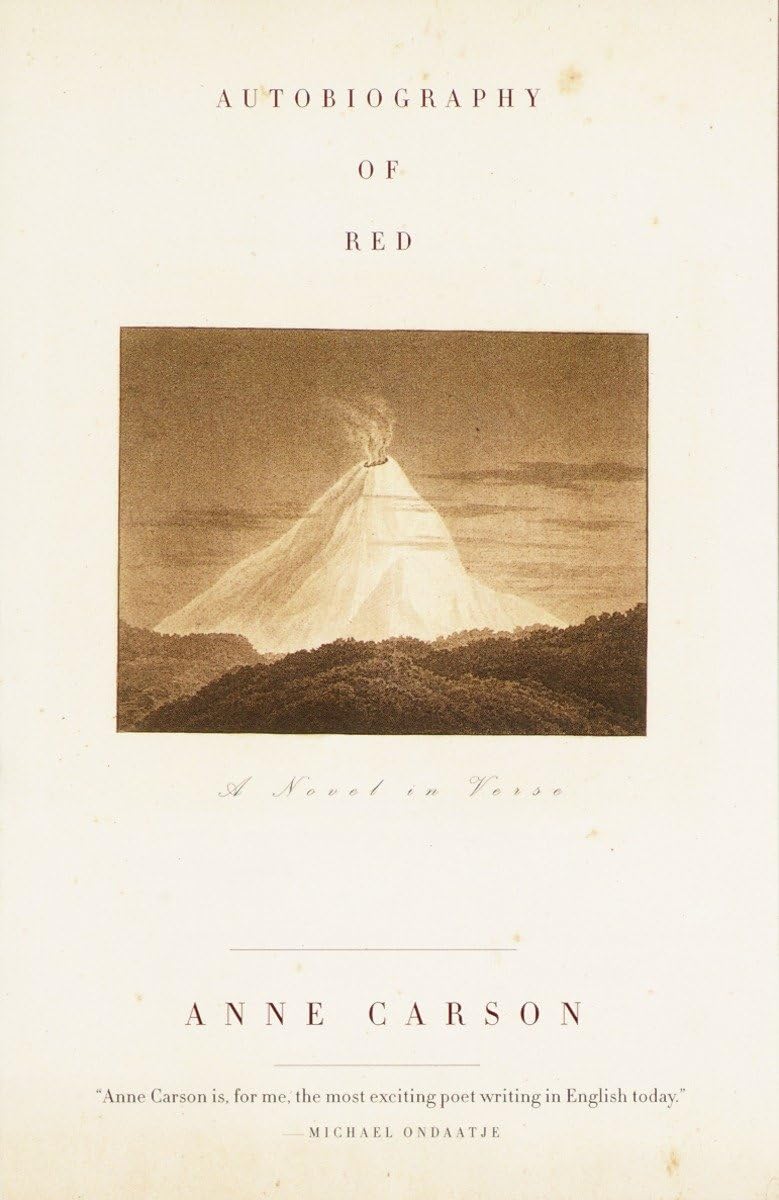
Cover image: Vintage (Penguin Random House), Autobiography of Red, used under fair use for review.
Congratulations to Anne Carson, who just won the 2026 Nobel Prize in Literature. Somewhere a committee in Stockholm read a novel in verse about a winged red monster with a crush, and decided it was time. I agree with them, which is not a sentence I get to write about the Swedish Academy very often.
The official line, announced on October 8, 2026, honors her “for her bold and inventive oeuvre that, in playful dialogue with the classical tradition, has created new forms for contemporary literature.” Translation for the rest of us: she reads ancient Greek for a living and then writes books that refuse to pick a genre. (Nobel press release)
Who she is, in about a minute
Carson was born in Toronto on June 21, 1950, and is 76. She earned her degrees in Classics at the University of Toronto (her 1981 doctoral thesis was titled Odi et Amo Ergo Sum), and she has taught Classics for more than thirty years, including at McGill and the University of Michigan. She lives in Ann Arbor, Michigan.
She writes poetry, essays, verse novels, opera libretti, and translations from Greek, and the line between those is mostly a suggestion. Before the Nobel, her shelf already held a MacArthur fellowship, the Griffin Poetry Prize (for Men in the Off Hours), and the T.S. Eliot Prize (for The Beauty of the Husband).
Here is the full catalog, then the three books I would actually hand a busy friend.
The catalog
Her major English-language books in publication order, with years from the Nobel Committee’s bibliography. Formats are what Amazon US lists right now; availability shifts, especially in a Nobel week, so check the product page before you buy.
- Eros the Bittersweet (1986): Her first book: a long essay on desire, built on Sappho’s word for love as bitter and sweet at once. The foundation for everything after. Formats: Paperback, hardcover, Kindle, Audible.
- Short Talks (1992): Tiny prose poems on everything from Kafka to walking backwards. Ideal for a five-minute wait. Formats: Paperback, Kindle.
- Plainwater: Essays and Poetry (1995): Essays and poems side by side, an early sign that she would never pick just one genre. Formats: Paperback, hardcover, Kindle, Audible.
- Glass, Irony and God (1995): Poems plus the essay “The Gender of Sound.” It opens with “The Glass Essay,” her most-loved long poem. Formats: Paperback.
- Autobiography of Red: A Novel in Verse (1998): The myth of Geryon, a winged red monster, retold as a sensitive teenager falling for Herakles. Often called her best. Formats: Paperback, hardcover, Kindle, Audible.
- Economy of the Unlost (1999): Scholarly but readable: the Greek poet Simonides read alongside Paul Celan. Formats: Paperback, hardcover, Kindle.
- Men in the Off Hours (2000): Shorter poems that pair unlikely minds, like Thucydides and Virginia Woolf. Won the Griffin Poetry Prize. Formats: Paperback, hardcover, Kindle.
- The Beauty of the Husband: A Fictional Essay in 29 Tangos (2001): A marriage falling apart in 29 sections, each opening with lines from Keats. Won the T.S. Eliot Prize. Formats: Paperback, hardcover, Kindle, Audible.
- If Not, Winter: Fragments of Sappho (2002): Her translation of Sappho’s surviving fragments. Formats: Paperback, hardcover.
- Decreation: Poetry, Essays, Opera (2005): Poems, essays, a screenplay, and an opera, circling Simone Weil’s idea of undoing the self. Formats: Paperback, hardcover.
- Grief Lessons: Four Plays by Euripides (2006): Four lesser-known Euripides tragedies in her sharp, modern English. Formats: Paperback, hardcover.
- An Oresteia (2009): One family’s ruin told by three playwrights: Aiskhylos, Sophokles, and Euripides. Formats: Paperback, hardcover, Kindle.
- Nox (2010): An elegy for her brother, made as an accordion-fold book in a box, threaded through Catullus’s poem for his own brother. Formats: Hardcover (boxed) only.
- Antigonick (2012): Sophokles’ Antigone, translated by Carson and illustrated by Bianca Stone. Formats: Paperback, hardcover, Kindle.
- Red Doc> (2013): Geryon’s story continues. Read Autobiography of Red first. Formats: Paperback, hardcover.
- The Albertine Workout (2014): Fifty-nine numbered paragraphs, with appendices, on Albertine from Proust. A pamphlet you can finish over lunch. Formats: Paperback.
- Float (2016): Twenty-two chapbooks you can read in any order. Commitment-phobes, this one’s for you. Formats: Hardcover, paperback.
- Norma Jeane Baker of Troy (2019): A version of Euripides’ Helen, titled with Marilyn Monroe’s birth name. Formats: Paperback, Kindle.
- H of H Playbook (2021): A facsimile of her own illustrated playbook on Euripides’ Herakles. Formats: Hardcover, Kindle.
- Wrong Norma (2024): A grab bag of short pieces, part essay, part performance, part art project. Formats: Paperback, Kindle, Audible.
She has also translated more Greek drama than fits here (Sophokles’ Electra, Euripides’ Bakkhai, and more). Start with the books above and you will find the rest on your own.
Where to start (for busy readers)
Carson has a reputation for being difficult. Some of that is earned. But the three books below are short, emotionally direct, and finishable in a weekend, which is my whole beat.
1. Autobiography of Red: the obvious first date
What it is: A novel in verse. Geryon, the red winged monster that Herakles kills in Greek myth, becomes a sheltered, sensitive teenager who falls hard for a charming Herakles who does not love him back in the same way. Years later they meet again in Buenos Aires, and it does not get simpler.
Who it’s for: Anyone who liked a sad, smart coming-of-age novel and is mildly scared of poetry. The lines read like prose with better timing.
How long: About 160 pages in paperback. The unabridged audiobook runs 3 hours and 55 minutes.
Formats: paperback, hardcover, Kindle, or Audible. Pick by mood. The verse layout is part of the fun, so print or Kindle gives you the full effect; audio is great for a second pass.
2. “The Glass Essay” (in Glass, Irony and God): the heartbreak one
What it is: A long poem, about 36 pages, that opens Glass, Irony and God. A woman whose lover has left her goes to stay with her mother on the moors, rereads Emily Brontë, and starts seeing a series of strange visions she calls the Nudes. It is about a breakup, a mother, and a dead novelist, and somehow all three at once.
Who it’s for: Anyone getting over someone. Also Brontë people. Especially Brontë people who are getting over someone.
How long: One sitting, maybe an hour. The whole book is slim if you keep going (do read “The Gender of Sound”).
Formats: I could not find a standalone edition of “The Glass Essay”; you get it in the collection. Amazon US currently lists Glass, Irony and God in paperback only, with no Kindle or Audible edition. Paper it is.
3. Nox: the one you have to hold
What it is: Carson’s elegy for her brother Michael, who drifted out of her life for years and died in 2000. It is a facsimile of a handmade book: one long accordion-fold sheet in a box, with photos, letters, collage, and her translation of Catullus’s poem 101, which Catullus wrote for his own dead brother.
Who it’s for: Anyone who has lost someone they never fully understood. Also anyone who thinks they know what a book is.
How long: Reviewers say you can read it in under an hour. Absorbing it takes longer.
Formats: Print only. Amazon US lists the boxed hardcover, and I found no Kindle or audio edition, which makes sense: the object is the point. Publisher New Directions notes temporary shipping delays, so order early if it is a gift.
Bonus: The Beauty of the Husband
If those three land, try this one next. A marriage to a beautiful, unfaithful man, told in 29 “tangos,” each opening with a line from Keats. It is funny in a bitter way. About 160 pages; the audiobook is just 1 hour and 40 minutes. Paperback, Kindle, or Audible.
Skip it if… you need a plot that goes A to B to C, or footnotes make you itch. Carson digresses on purpose, quotes dead Greeks mid-sentence, and expects you to keep up. If that sounds tiring, start with Autobiography of Red and stop there. No shame.
Wins and watch-outs
Wins
- Short books: the three starter picks are each a weekend or less.
- Real feelings: heartbreak, grief, and longing come through the clever parts, not around them.
- Format variety: Autobiography of Red works in print, on Kindle, or on Audible; Nox is a paper experience you cannot get anywhere else.
- Ancient Greek with no homework: you do not need to know who Stesichoros was. She tells you, and it’s fun.
Watch-outs
- Genre whiplash: poem, essay, and footnote can happen on the same page.
- Not all of it is easy: the scholarly titles (Economy of the Unlost, say) are for later, not first.
- Limited formats on some favorites: Glass, Irony and God and Nox are print only on Amazon US right now.
- Nobel-week stock: expect some delays while everyone else discovers her too.
Bottom line
The Nobel committee got this one right. Start with Autobiography of Red, keep Nox for when you want something you can hold, and save “The Glass Essay” for the next time your heart needs a long walk on a moor.
Behind the bookmark

Lane Adler
Lane Adler writes Aladyne Reads for busy people who still want the next good read. He covers Personal Growth plus Romance, Thriller, Mystery, Sci-Fi, and Fantasy, and picks books he’d actually recommend to a friend. Life doesn’t leave much quiet couch time—so the reviews lean Audible and Kindle, with print still welcome when you want paper in hand.
